
Here are some of the notes I took from the one day Discovery Education conference. The record has been supplemented by tweets from #futurenow. Some of the sessions were quite short, so I don’t have great notes for some really interesting speakers! I will try to supplement them later as I find more material.
How do we implement a plan for creating a digital transformation? That is the theme for today.
First session – The Call to Action – Student Speak – how digital learning is impacting the lives of students.(trying to upload this!)
Dr David Dance – Superintendent Baltimore County Public Schools @DDance_BCPS
- conversion starts with engaging community. “Build a case for the urgency of now”
- If the infrastructure is not there this is not going to work –
- really makes sure they have strong partners in the community
- Lighthouse schools – application to become school labs – teachers need to vote to become a Lighthouse school
- digital transformation started with elementary!!
- digital conversation is about making edication individualized for all students
- we have to build cultures where risk taking is part of the culture
- status quo is not acceptable – we only get one chace to work with our children
- our goal – to deveop students who can compete on a global level
- School districts need to partner with groups like Discovery Ed to plan the transition
- Technology allows students to take responsibility for their learning
- Our world is digital. Schools can no longer ignore this fact…our students need opportunities to excel in the digital world.
- The cost for infrastructure should not be so unattainable and exorbitant that the implementation of digital learning is halted
US Representative George Miller – Senior Democrat House Education and Workforce Committee
We are making that transition to digital schools by bringing students, teachers, parents and the community on side.
“There’s a magnificent bonfire [of education innovation] burning across this country.”
The achevement gap does not have to be a constant – we are inspiring education in and outside of the school through new initiatives
Universal access for ALL students to online resources is critical to successfully transition to new educ paradigm
Politicians can take ownership of the system so that we can get the resources we need in our schools!
live audience at Furure@Now conference
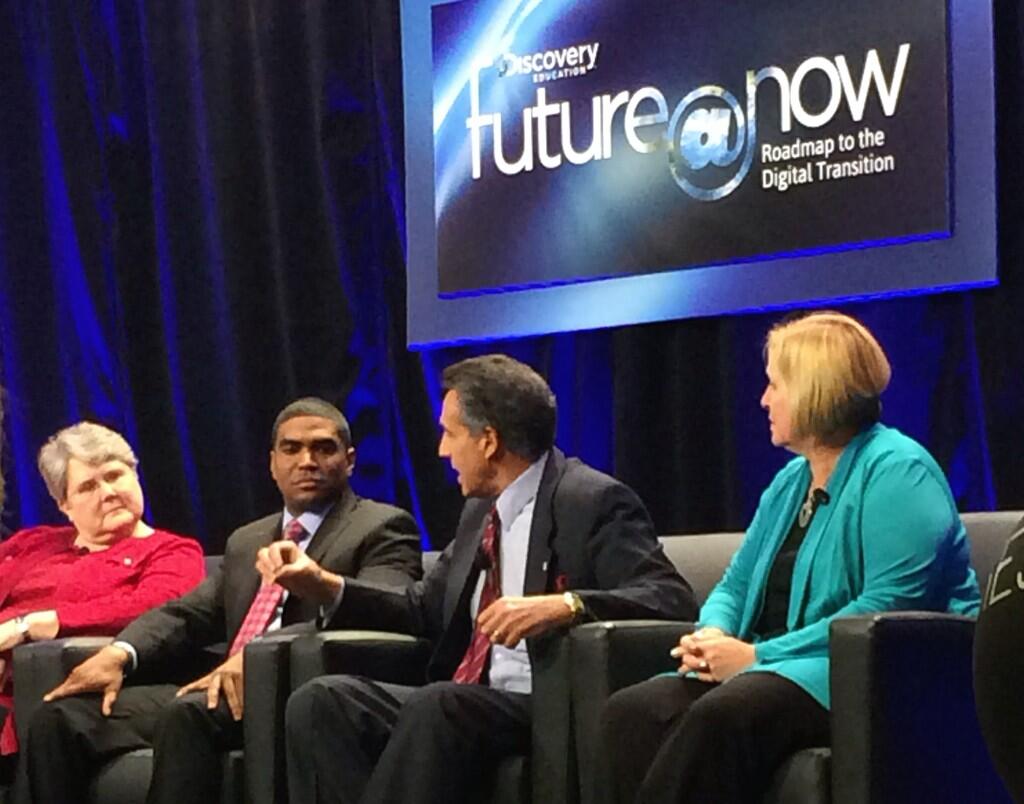
Digital Transformation – panel discussion
- in Baltimore county – your transformation has to be site specific
- Baltimore site – bcps.org/academics/stat/
How do you measure success in implementation?
- “Measures of success? Funding Infrastructure and finding innovative ways to inspire”
- other meaures? Accelerating outcomes for all students
- looking also to ‘repurpose’ our spending. Difficult to do since the vast majority of spending is on staff
- a case can be built for ‘if we don’t spend it now, we will spend it later’ – investing in our students
- centralize spending on technology to allow for bulk buying discounts
- have to demonstrate our early wins so that we can leverage what we are learning to allow for future investment (Lighthouse Schools)
Chris Kennedy @chrkennedy – next speaker – Superintendent of Schools – West Vancouver
- OWN IT, ACTIVATE IT, ENGAGE WITH IT. I say ALL parties should do ALL. You gain a wealth of ideas,creativity, & henceforth
- Conversations over BYOD is the wrong conversation. If we are spending time talking about digital, there is probably a conversation on education we need to have first.
- if your community is fighting about digital there’s conversation missing–should be about learning!
Chris’ full presentation can be found here
Related articles


 Whole-Hearted