
Episode 38
Julia Jacklin – I was Neon
Arctic Monkeys – There’d Better Be a Mirrorball
Men I Trust – Billie Toppy
Michael Head & The Red Elastic Band – Grace and Eddie
OMBIIGIZI, Status/Non-Status, Zoon – Cherry Coke
Sister Ray – Visions
The Handsome Family – Gold
Lizzo – About Damn Time
Fontaines D.C. – Jackie Down the Line
Bob’s Notes
Arctic Monkeys – “There’d Better Be a Mirrorball”
The Arctic Monkeys are a band formed in Sheffield, England in 2002. They are sometimes mentioned as one of the first bands who gained their initial buzz and popularity due to the internet. As a result in 2006, “Whatever People Say I Am, That’s What I’m Not” became the fastest-selling debut album in UK history. The band became a Brit. fave winning numerous awards but it wasn’t until 2013 that the band became more universally known with the release of its 2015’s album AM. The song featured here is taken from The Car, the seventh studio album.
Lizzo – “About Damn Time”
Lizzo, is an American singer and rapper from Houston, Texas. She attained immense popularity with the release of her third studio album, Cuz I Love You (2019), which peaked at number four on the US Billboard 200. About Damn Time” was lead single from the album Special released earlier this year. The song was nominated at the 2022 MTV Video Music Awards for Song of the Year, Best Pop Video, and Song of Summer. The song also received three nominations at the 65th Annual Grammy Awards for Record of the Year, Song of the Year and Best Pop Solo Performance. Here she is performing “About Damn Time” on SNL.
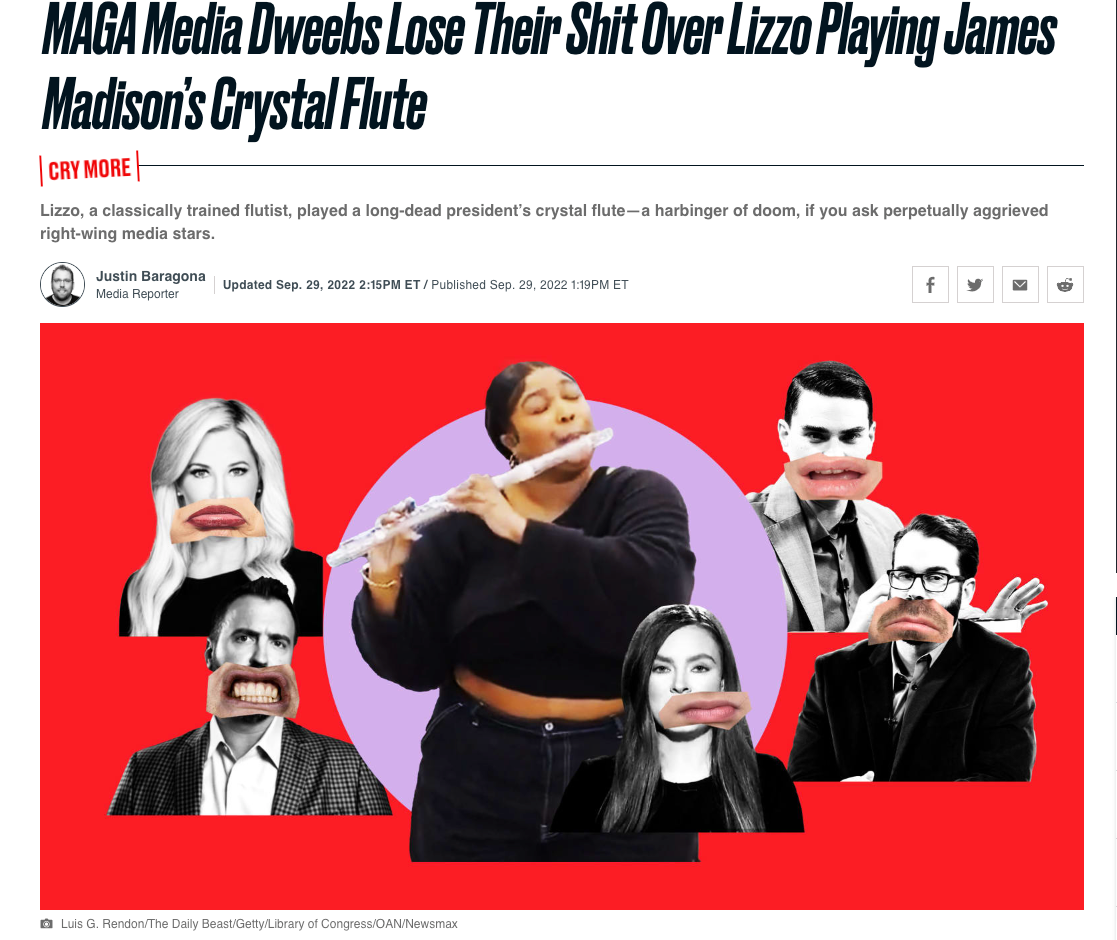
Fun fact- Lizzo is also a classically trained flautist. Back in September, she caused the American right to get all huffy when she played James Madison’s silver flute.
Michael Head & The Red Elastic Band – “Grace and Eddie”
Michael William Head is an English singer-songwriter and musician from Liverpool, England. He is most famous as the lead singer and songwriter for Shack, The Pale Fountains and Michael Head & The Strands. Some have described him as a lost genius and among the most gifted British songwriters of his generation. In 2013 he formed Michael Head & The Red Elastic Band. In 2017, Michael Head & The Red Elastic Band released an album called Adiós Señor Pussycat. It reached No 1 in the UK independent album chart and No. 57 in the UK Albums Chart. The new one, Dear Scott was released in June 2022. The tile is apparently inspired by a note F. Scott Fitzgerald wrote to himself.
The album peaked at number 6 in the official UK chart, making it Michael Head’s highest-ever charting album. Here’s a version performed live. I don’t know who Grace and Eddie are.
Flash back to the early eighties! Michael Head in The Pale Fountains
Sister Ray – “Visions”
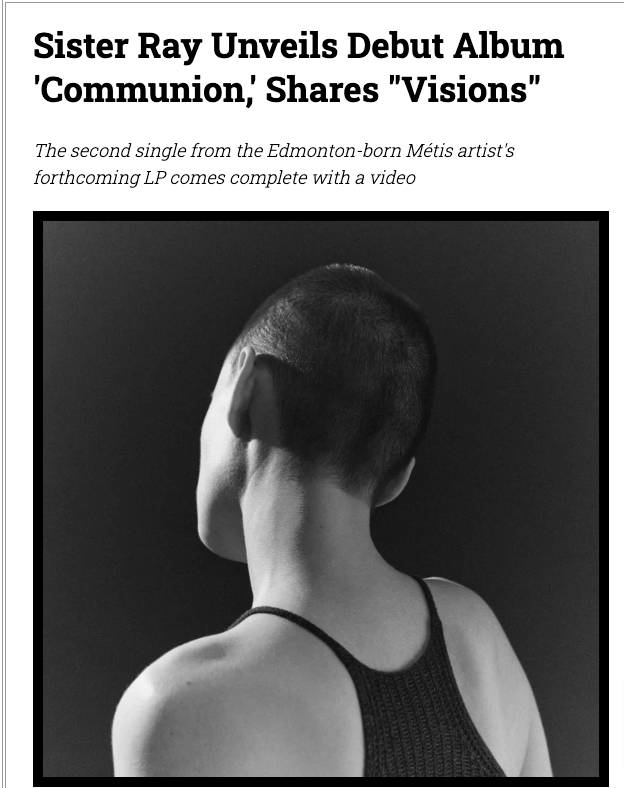
Sister Ray is the stage name of Ella Coyes, a Métis singer-songwriter. They were born and raised in Sturgeon County, Alberta. Their debut full-length album Communion was released in May 2022. Exclaim explains:
Also, though four years old, this interview provides excellent background to Sister Ray.

Here’s the strangely beguiling video.
Paul’s Notes
Julia Jacklin – I was Neon
This is her third album Pre Pleasure – “Pre Pleasure is an easygoing album from a mind that rarely stops racing.“
One of the songs from the album, not the one I am playing, is #94 on Pitchfork’s 100 Best Songs of 2022
The Australian songwriter’s empathetic, understated rock songs sift through a litany of relationships and beliefs, seeking a balance between thinking about life and actually living it.
“I Was Neon,” in which she wonders if a version of herself has been lost to time. “I quite like the person that I am/Am I gonna lose myself again?” she repeats, voice roiling with equal parts anxiety and excitement. If she could reach through the photograph and make contact with that incarnation of herself, what would she say?
It seems like many of the artists I am choosing are writing about being lost.
Julia Jacklin (born 30 August 1990) is a singer-songwriter from the Blue Mountains, Australia. Jacklin’s musical style has been described as indie pop, indie folk, and alternative country. from Wikipedia
Men I Trust – Billie Toppy
(singe 2022, last album Untourable Album 2021)
The information about this band is somewhat dreamy, and so is their music. It is interesting that the two founders of the band actually played with a rotating series of lead singers, settling on Emma Proulx, the face of the band some time in 2015.
From their dreamy Bandcamp article:
Mixing dreamy atmospheres, wistful extended chords, and funky, low-key dance grooves, Men I Trust was the brainchild of then-Laval University music students Dragos Chiriac and Jessy Caron. The Montreal, Canada D.I.Y. project made its full-length debut with Men I Trust in 2014. While the duo’s first two albums employed a variety of guest vocalists, singer Emmanuelle Proulx has been an official member since 2015. Their third studio album, 2019’s Oncle Jazz, was long-listed for 2020 Polaris Music Prize. Untourable Album followed in 2021 and was ultimately accompanied by a tour.
In June 2021, the band announced the release of their 4th album “The Untourable Album” along tour dates to support the release. Men I Trust posted on their social medias about the release and the tours, elaborating on their context:
Cherry Coke – OMBIIGIZI, Status/Non-Status, Zoon

Another song I like more every time I hear it. I think we have played Status/Non-status before, but Zoom is new to the show.
Zoon and Status/Non-Status have shared a new single, “Cherry Coke,” under their collaborative project, OMBIIGIZI. The track comes from their forthcoming debut album, Sewn Back Together, out February 10th via Arts & Crafts.
“Cherry Coke” is a dreamy, shoegazy tune with smooth instrumentals that allow OMBIIGIZI’s smooth vocals to take the lead. Lyrically, the song is about Zoon’s Daniel Monkman’s childhood.
“I used to get into a lot of fights at school when I was younger,” the band’s Daniel Monkman explains. “One of the schools was called ‘Happy Thought’ which ironically was filled with racist rural farmer type folk. I think as a type of punishment my Mom sent me to live with my Dad on the Rez, so he could show me how to be a ‘man.’ Although my Dad was a very complex human, he was very compassionate towards me, especially when I explained how the kids would tease me for being Ojibway. He’d always let me stay home with him and oftentimes we’d go to the Rez store for chips and pop; I’d get Cherry Coke or Vanilla Coke. The lyrics and song title are inspired by these memories of my childhood and of my father.”
After quoting 88FM, I had to look them up. A very interesting station from Toronto. They are doing some interesting work featuring indie bands.
and the OMBIIGIZI video for Cherry Coke
Gold – The Handsome Family
I heard about this band last week when Bob played a Phoebe Bridgers cover of their song So Much Wine.
The Handsome Family is an American music duo consisting of husband and wife Brett and Rennie Sparks formed in Chicago, Illinois, and as of 2001 based in Albuquerque, New Mexico.[1] They are perhaps best known for their song “Far from Any Road” from the album Singing Bones, which was used as the main title theme for the first season of the 2014 crime drama True Detective. The band’s tenth album, Unseen, was released on September 16, 2016, the first new release on the band’s own label Milk & Scissors Music[2] and through long-time label Loose in Europe
(Wikipedia)
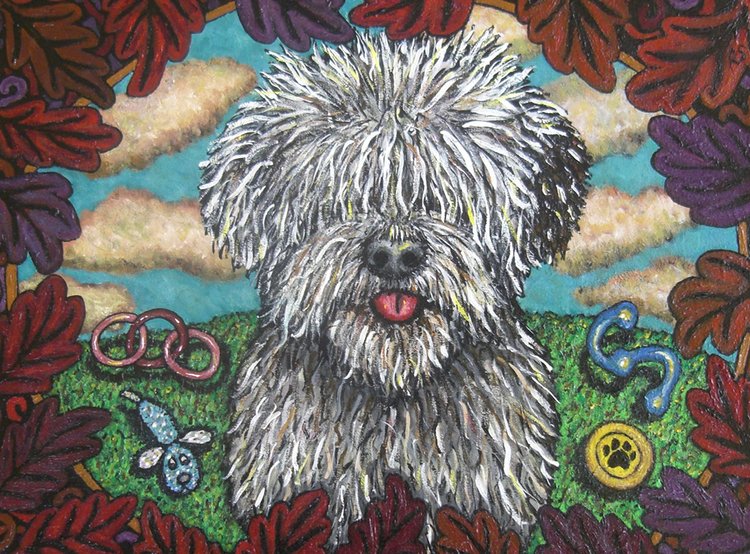
And, to top all this off, Rennie Sparks is an artist. She has done a wonderful series of dog paintings – I have included one here.
HOLLOW, their tenth studio record, is planned to be released in 2023 with live touring hopefully to follow.
Jackie Down the Line – Fontaines D.C.
The Irish post-punk band’s most demanding and musically adventurous album is also its most open-hearted, striking a perfect balance between tough and tender.
The year 2019 already feels like the distant past for most of us, but for Fontaines D.C., it really must seem like another lifetime—and that has less to do with the pandemic than their own skyrocketing success in spite of it. Pretty much everything that defined this band three years ago, when they dropped their debut LP, Dogrel, has already changed. Once the scrappy underdogs who ironically declared “I’m gonna be big!”, the Dublin-bred quintet have headlined arena shows for crowds of 10,000 in the UK, appeared on CNN, scored a Grammy nomination (outside the Alternative category ghetto, no less).
Fontaines D.C. are an Irish post-punk band formed in Dublin in 2017.[1][2][3] The band consists of Grian Chatten (vocals), Carlos O’Connell (guitar), Conor Curley (guitar), Conor Deegan III (bass), and Tom Coll (drums).
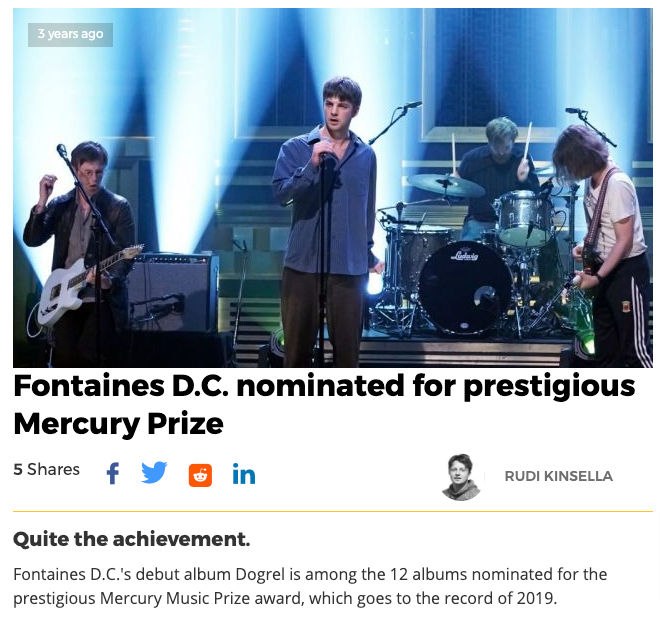
The band’s debut album, Dogrel, was released on 12 April 2019 to widespread critical acclaim; it was listed as Album of the Year on the record store Rough Trade‘s website,[4] voted Album of the Year by presenters on BBC Radio 6 Music,[5] and was nominated for both the Mercury Prize and the Choice Music Prize.[6]
The band’s second studio album, A Hero’s Death, was written and recorded in the midst of extensive touring for their debut, and was released on 31 July 2020. A Hero’s Death was later nominated for Best Rock Album at the 2021 Grammy Awards. Their third album Skinty Fia, released in 2022, became the band’s first to reach number one on the UK Albums Chart and Irish Albums Chart.
Its title refers to an old Irish saying that drummer Tom Coll’s great-aunt used to say. The phrase “Skinty Fia” translates to “the damnation of the deer”. Both the title and the cover art allude to the extinct Irish elk, also known as the “giant deer”
Wikipedia
 Whole-Hearted